

Australia certificate attestation for the UAE runs through three main stages that do not begin with an apostille: authentication by Australia’s Department of Foreign Affairs and Trade (DFAT), requested as an Authentication, not an Apostille; then legalization by the UAE Embassy in Canberra or its Consulate-General in Sydney, depending on the state where the certificate was issued; then attestation by the UAE Ministry of Foreign Affairs. Even though Australia belongs to the 1961 Hague Apostille Convention, the UAE is not a party to it, so an Australian apostille on its own is never accepted, whatever the certificate type or the authority requesting it.
This guide explains the difference between an apostille and an Authentication, the correct route depending on where your certificate is right now, and the truth behind a common claim: whether the Australian Embassy attests documents issued in the UAE.
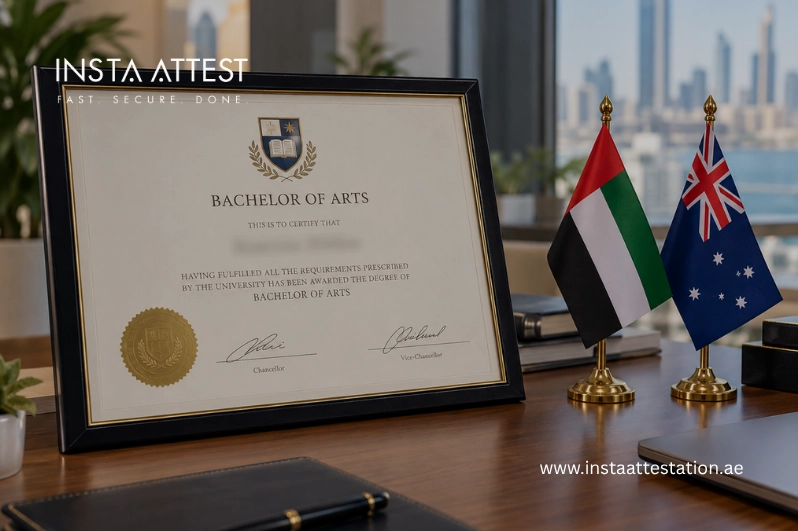
Why an Australian Apostille Alone Is Not Enough in the UAE
Because Australia belongs to the Hague Apostille Convention, many people wrongly assume that an apostille issued by DFAT is enough to have their certificate accepted anywhere, including the UAE. In fact, an apostille is only accepted between two countries that are both members of the Convention, and the UAE is not a party to it at all.
This is stated explicitly in the official guidance published by the Australian Embassy in Abu Dhabi, and on Smartraveller, the Australian government’s consular services site: a document headed to a country outside the Hague Convention needs, instead of an apostille, an Authentication from DFAT, followed by the full consular legalization chain ending with the attesting authority in the destination country.
The practical difference is that an apostille is a single stamp that finishes the process immediately between two member states, while an Authentication is only the first step of a longer chain that continues with the UAE Embassy in Australia and then the UAE Ministry of Foreign Affairs.
Need your Australian certificate attested? Send us a photo of it on WhatsApp, and we will map out the correct route within minutes. Message us on WhatsApp or call us.
Where Do You Start? Two Routes Depending on Where the Certificate Is Now
Where your certificate is right now determines the first step in the route:
The certificate is still in Australia
It is submitted to DFAT for an Authentication, not an apostille. Some Australian universities also require the degree certificate to be verified with the university itself, or through an accredited verification service, before it is presented to DFAT.
The certificate is already with you in the UAE
There is no need to send it to Australia. The Australian Embassy in Abu Dhabi and the Consulate-General in Dubai offer a similar local authentication service (a certified-copy service, or an authentication/apostille issued on DFAT’s behalf) by prior appointment.
Stages of Attesting an Australian Certificate for the UAE
The document then moves through the following stages:
Australian Documents Covered by This Process
| Document category | Documents included |
|---|---|
| Educational certificates | University certificates at every level, diplomas, and their attached transcripts |
| Civil status certificates | Birth, marriage, divorce and death certificates |
| Good conduct certificates | Police Clearance Certificates |
| Commercial documents | Incorporation deeds, good-standing certificates, and board resolutions |
| Other documents | Powers of attorney and declarations executed in Australia |
If your document is not in this table, do not assume it cannot be attested; contact us and we will confirm.
Have a document you don’t see in the table? Send us the details, and we will confirm whether it can be attested and the right route for it. Message us on WhatsApp.
Does the Australian Embassy Attest Documents Issued in the UAE?
This question comes up often, and the precise answer saves you a step that leads nowhere: no. Unlike other countries’ missions in Dubai, which attest their own documents when issued for use back home, the Australian Embassy in Abu Dhabi and the Consulate-General in Dubai do not attest any document issued in the UAE; their notarial and consular services are limited to Australian documents only, as stated explicitly in official guidance from Australia’s foreign ministry and from the Embassy itself.
In practice, if you have a UAE document headed to Australia, it does not pass through any Australian mission in the UAE at all. The usual route is to have it attested by the UAE Ministry of Foreign Affairs, with a certified translation if needed, then submitted directly to the Australian authority that requested it, because Australia does not run a consular legalization system for incoming documents the way some other countries do. Exact requirements vary by the requesting authority, so it is worth confirming them specifically. You can find a fuller explanation of attesting UAE-issued personal documents on our personal document attestation page.
Apostille vs. Authentication: What’s the Difference?
Both are issued by the same authority, DFAT, to confirm that a signature or seal on a document is genuine. But an apostille is designed for exchange between countries that are both members of the Hague Convention, with a single stamp that removes the need for any further legalization. An Authentication is the form required by non-member countries, such as the UAE, and it is only the first step of a longer chain that does not end until the UAE Ministry of Foreign Affairs attests the document. For more on apostilles themselves and why they are not accepted alone in the UAE more broadly, see our guide What Is Apostille Attestation?
Frequently Asked Questions About Australian Certificate Attestation
Is an Australian apostille enough to use my certificate in the UAE?
No. The UAE is not a party to the Hague Convention, so it does not recognize an apostille from any country. You need DFAT authentication first, then legalization by the UAE Embassy in Canberra or its Consulate-General in Sydney, then attestation by the UAE Ministry of Foreign Affairs.
My original certificate is already with me in the UAE — do I need to send it to Australia?
Not necessarily. The Australian Embassy in Abu Dhabi and the Consulate-General in Dubai offer a local authentication service by prior appointment, sparing you from sending the certificate to Australia.
Does the Australian Embassy in Dubai attest documents issued in the UAE?
No. The Embassy’s and Consulate’s notarial services are limited to Australian documents only. A UAE document headed to Australia is attested solely by the UAE Ministry of Foreign Affairs, then submitted directly to the Australian authority requesting it.
How long does attesting an Australian certificate take?
The timeline depends mainly on how quickly the first step is completed, especially if the certificate is still in Australia. Once it arrives legalized from the UAE Embassy there, the UAE Ministry of Foreign Affairs step here takes only a short time.
Does my university certificate need to be verified by the university first?
Some Australian universities require this before the certificate is presented to DFAT, and it varies by the issuing institution.
Do I need to travel to Australia to complete the process?
No, if the certificate is with you in the UAE. If it is still in Australia, we coordinate with our agent there to complete the DFAT authentication on your behalf, with no need for you to travel.
Do you also handle certified legal translation?
Yes, if your certificate needs a certified Arabic translation, we provide it as part of the same transaction through our certified legal translation service.
Where does this information come from?
We relied on official guidance published by Australia’s foreign ministry and its Embassy in Abu Dhabi, alongside a review of real accounts from people who have gone through the process.
For more on the general attestation rules in the UAE, browse our MOFA Attestation Dubai page.
Contact us today. Call or WhatsApp us on +971589194228, or visit us at Opal Tower, 8th Floor, Business Bay, Dubai, from 9 am to 6 pm. Contact page
