

Apostille attestation is a standard international certificate, issued by a designated authority in the country where a document was produced, that confirms the signature and seal on that document so it can be accepted directly in any other country that belongs to the 1961 Hague Apostille Convention, with no embassy legalization required. The UAE, however, is not a party to the Convention. An apostille alone is therefore not enough for a foreign document to be accepted here: it must still pass through the full consular chain, from the issuing country’s foreign ministry to the UAE Embassy in that country and finally to the UAE Ministry of Foreign Affairs.
This guide explains what an apostille does and does not prove, how to recognize one and check that it is genuine, how it differs from consular legalization, and the correct route for your document in both directions: coming into the UAE, or leaving it.
What Is Apostille Attestation?
The word “apostille” comes from French, where it means a note written in the margin or at the foot of a page. It later became the name of the certificate created by the Hague Convention of 5 October 1961, formally the Convention Abolishing the Requirement of Legalisation for Foreign Public Documents.
Before the Convention, a document crossing a border had to travel from office to office: from the foreign ministry of its own country to the embassy of the destination country, with each authority vouching for the stamp of the one before it. The Convention replaced that chain with a single certificate, issued by an authority that each member state designates for itself, such as its foreign ministry, justice ministry or courts. Once a document carries this certificate, every other member state is bound to accept it without further certification from its embassies.
The Convention has grown steadily and, according to the latest update from the Hague Conference on Private International Law in June 2026, now counts 130 contracting parties. They include the United Kingdom, the United States, India, the Philippines, China and Pakistan, and, among Arab states, Saudi Arabia, Bahrain, Oman, Morocco, Tunisia and Algeria.
What Apostille Attestation Proves, and What It Does Not
Article 5 of the Convention states that an apostille certifies three things only: the authenticity of the signature on the document, the capacity in which the signatory acted, and, where relevant, the identity of the seal or stamp the document bears.
In other words, apostille attestation says nothing about the content of the document and does not guarantee that what it states is true. An apostille on a university degree confirms that the official who signed it was authorized to do so and that the university’s seal is genuine. It does not confirm that the holder actually passed the course. Nor does it replace translation: if the document is in a language the receiving authority does not accept, a certified translation is still required. And it does not oblige that authority to accept a document that fails its own conditions, such as a requirement that the document be recently issued.
What Does an Apostille Look Like?
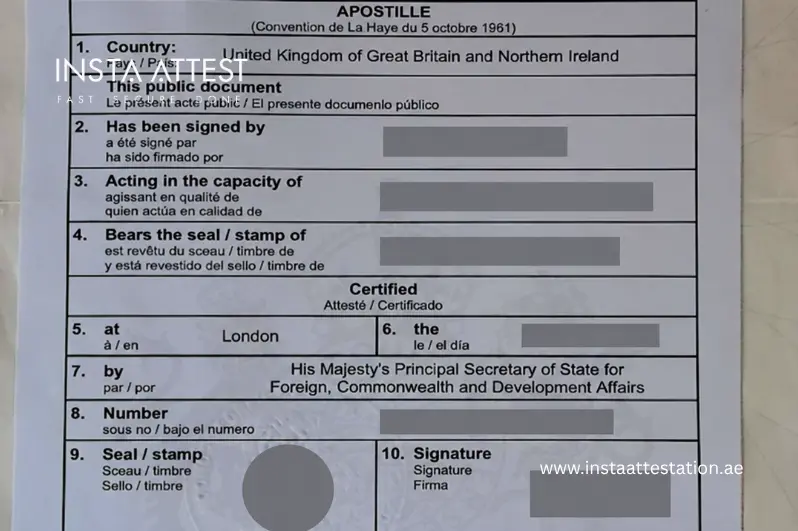
Apostille attestation usually takes the form of a square certificate, either fixed to the document itself or attached to it. It is headed with the word Apostille, followed by the title of the Convention in French: Convention de La Haye du 5 octobre 1961. Below this sit ten numbered fields, in the same order in every member state:
- The country where the document was issued.
- The name of the person who signed it.
- The capacity in which they signed.
- The authority whose seal the document bears.
- The place where the apostille was issued.
- The date of issue.
- The authority that issued it.
- Its serial number.
- That authority’s seal or stamp.
- The signature of the issuing official.
The French heading never changes, while the fields may appear in the language of the issuing country.
In recent years many countries have begun issuing electronic apostilles (e-Apostilles) as digitally signed files, and many run an online register (e-Register) where a recipient can confirm an apostille using its number and date. That register is the quickest way to make sure the certificate in front of you is genuine before you spend time on any further step.
Which Documents Qualify for Apostille Attestation?
The Convention applies to what it calls “public documents”, which it divides into four groups:
- Court documents, such as judgments and divorce decrees.
- Administrative documents, such as birth, marriage and death certificates, and police clearance certificates.
- Notarial acts, such as powers of attorney and sworn declarations.
- Official certificates placed on private documents, such as a record that a document was registered on a given date, or a certification of a signature.
Two categories are excluded: documents executed by diplomatic or consular officers, and administrative documents dealing directly with commercial or customs operations. This is why countries differ in how they handle certain commercial papers, such as invoices and certificates of origin.
Private documents, such as a certificate from a private university or a contract between two parties, usually need an intermediate step in their home country before an apostille can be added, typically notarization or certification by the relevant education authority, so that they become public documents eligible for certification.
Apostille Attestation vs. Consular Legalization
Both systems serve the same purpose: reassuring the receiving country that a foreign document genuinely comes from the authority that appears to have issued it. They reach that goal in fundamentally different ways:
| Apostille | Consular legalization | |
|---|---|---|
| When it applies | When both the issuing country and the destination country are parties to the Hague Convention | When either country, or both, is outside the Convention, as the UAE is |
| Number of stages | A single certificate in the issuing country | A chain of stamps that begins in the issuing country and ends in the destination country |
| Role of the destination country’s embassy | None | An essential link; the document is not accepted without it |
| Format | A standard certificate with ten fixed fields | Stamps and stickers that vary from one authority to the next |
| Timeframe | Usually shorter | Longer, because several authorities are involved and the document must travel between them |
Most importantly, the choice between the two is not yours to make. It is decided by whether both countries belong to the Convention. If either one does not, consular legalization is the only route, however many stamps the document already carries.
Does the UAE Accept Apostille Attestation?
No. The UAE is not a party to the Hague Apostille Convention, nor is it a member of the Hague Conference on Private International Law that administers it. Two consequences follow.
First: a foreign document bearing an apostille will not be accepted in the UAE on the strength of that apostille alone. The UAE Ministry of Foreign Affairs attestation guide requires a foreign document to be attested by the UAE Embassy in the issuing country before the Ministry will attest it.
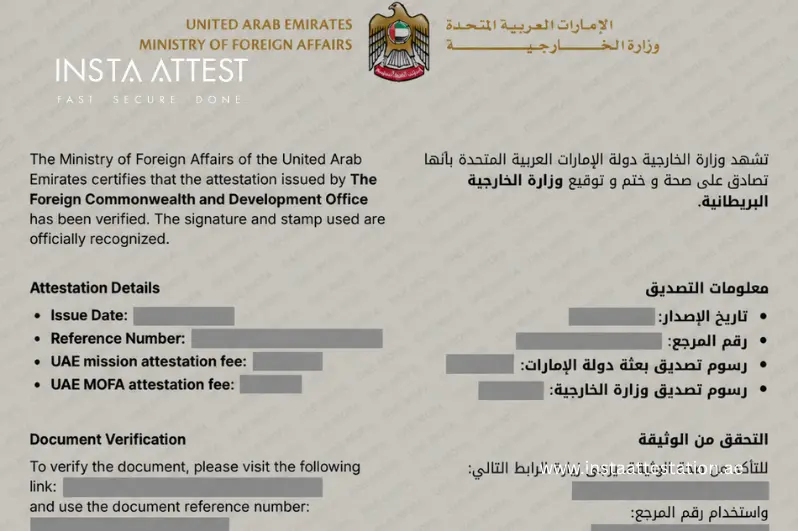
Second: no authority in the UAE issues apostilles on UAE documents. What is sometimes marketed as a “UAE apostille” is in fact consular legalization: attestation by the UAE Ministry of Foreign Affairs, followed by the embassy of the destination country.
The picture is different elsewhere in the Gulf. The Convention entered into force for Saudi Arabia in December 2022, for Bahrain at the end of 2013 and for Oman at the start of 2012, while Kuwait and Qatar have not joined to date, and neither has Egypt, so a UAE document headed there still needs full Egypt embassy attestation. It is therefore worth checking each country’s position individually rather than assuming it matches its neighbors.
Your document carries an apostille and you need it in the UAE? Send us a photo, and we will tell you within minutes which stamps are still missing and what comes next. Message us on WhatsApp or call us.
A Foreign Document with an Apostille: How It Is Accepted in the UAE
Your apostille attestation is rarely wasted in this situation, but it becomes the first link in the chain rather than the last. In some countries, the foreign ministry’s certification itself takes the form of an apostille. In the United Kingdom, for example, the FCDO Legalisation Office places an apostille on the document, which then goes to the UAE Embassy in London. In other countries, such as India, the foreign ministry issues an ordinary attestation instead of an apostille for documents destined for a non-member state. We explain that route for Indian documents in our guide to UAE MOFA attestation in India. The same applies to Australia: a DFAT apostille alone is not enough to use an Australian certificate in the UAE, and we’ve mapped out the full route step by step in our guide to Australia certificate attestation for the UAE. Either way, the document then follows these steps:
A practical example: a British university degree needed for an employment contract in Dubai. The degree is first certified by a solicitor or notary in the UK, then receives an apostille from the FCDO Legalisation Office, then is attested by the UAE Embassy in London, then by the UAE Ministry of Foreign Affairs, and finally translated into Arabic if the receiving authority asks for it. Had the degree been shipped to Dubai the moment it received its apostille, its holder would have had to send it back to London.
The part of this route that we handle, from UAE Embassy attestation in the issuing country to UAE Ministry of Foreign Affairs attestation and delivery, usually takes up to 5 working days, depending on the country and the speed of couriers there. You can find the details of this route for each document type on our personal certificate attestation page, or in our guide to marriage certificate attestation in the UAE.
Your document is abroad and you are in the UAE? There is no need to travel. We coordinate with the UAE Embassy in the issuing country, our courier collects the document from your address there, and we complete UAE Ministry of Foreign Affairs attestation and translation until it reaches you ready to use. Start on WhatsApp.
A UAE Document Needed in a Country That Uses Apostilles
It may seem logical that a UAE document heading to a Convention member country needs only an apostille, but the Convention applies only between two member states. Because the UAE is not one of them, a UAE document follows the consular route even when the destination country is a member:
- Certification by the issuing authority, which today is electronic for most government documents, such as marriage contracts issued by Dubai Courts.
- Attestation by the UAE Ministry of Foreign Affairs, which we complete in one working day for electronically certified documents.
- Attestation by the destination country’s embassy or consulate in the UAE, explained in detail on our document legalization services page.
Countries vary widely at this third step. Some embassies require a certified translation into their own language, while others do not legalize documents at all and follow a different procedure set by their own authorities. It pays to confirm the destination country’s requirements before you begin, not after the document has been returned by the embassy.
Common Mistakes About Apostille Attestation
Shipping the document to the UAE as soon as it receives an apostille. This is the costliest mistake of all, because UAE Embassy attestation can only take place in the issuing country, so the document has to go back, and the time lost could have been saved.
Assuming apostille attestation replaces translation. An apostille confirms the signature and seal only. It changes nothing about the language of the document.
Relying on a photocopy of the certified document. An apostille is attached to one specific document, and a photocopy does not carry its legal weight, unless a certified copy is treated as a separate document under the rules of the issuing country.
Confusing an apostille with notarization. A notary witnesses a person’s signature on a document, while an apostille confirms the signature of the public official, including the notary’s own signature. That is why notarization usually comes first, followed by the apostille. If you need a document notarized in the UAE, see our notary public services in Dubai.
Do not risk a document being sent back. Send us a photo before you ship it, and we will check its stamps and tell you what is missing. Send the photo on WhatsApp.
How Insta Attestation Services Can Help
No authority in the UAE can issue an apostille, but everything that comes after the apostille is exactly what we do best. Over more than ten years of Ministry of Foreign Affairs and embassy work, we have handled documents arriving from Convention countries and beyond, as well as UAE documents heading abroad:
- Coordinating with the UAE Embassy in the issuing country and collecting your document from your address there.
- UAE Ministry of Foreign Affairs attestation for both foreign and UAE-issued documents.
- Attestation by the destination country’s embassy in the UAE for documents going abroad.
- Certified legal translation within the same transaction.
- Door-to-door collection and delivery anywhere in the UAE, with no need for you to visit.
Frequently Asked Questions About Apostille Attestation
Can I get an apostille in the UAE?
No. The UAE is not a party to the Hague Convention, and no authority in the country issues apostilles. A UAE document going abroad is attested by the UAE Ministry of Foreign Affairs and then by the embassy of the destination country.
Is apostille attestation enough to submit a foreign document to a UAE authority?
No. The document must then be attested by the UAE Embassy in the issuing country and by the UAE Ministry of Foreign Affairs, and translated into Arabic if required.
Does apostille attestation expire?
The Convention sets no expiry date for an apostille; it remains valid proof of the signature for as long as the document exists. The receiving authority may, however, require the document itself to be recent, as is common with police clearance certificates, which are usually requested within a few months of issue.
How can I verify an apostille attestation?
Many countries offer an online register where you can check an apostille using its number and date, which appear in fields 8 and 6 of the certificate. If no register is available, you can contact the issuing authority directly.
Is an electronic apostille accepted?
It is accepted between member states that use it. For the UAE route, what matters is the requirements of the UAE Embassy in the issuing country, so it is worth confirming them before you start.
Do I need to travel to the issuing country for UAE Embassy attestation?
No. We coordinate with the embassy, our courier collects the document from the address you give us there, and we complete UAE Ministry of Foreign Affairs attestation before delivering it to you.
What is the difference between an apostille and notarization?
A notary certifies the signature of the person signing a document or confirms that a copy matches its original, while an apostille confirms the signature and seal of the public official, including the notary. They are consecutive steps, not alternatives.
How much does the service cost?
The cost depends on the type of document and the country it comes from or is going to. Get in touch and we will explain everything before we begin.
Know Your Document’s Route Before You Start
Apostille attestation is a clever shortcut between Convention countries, but in the UAE it marks the beginning of the journey, not the end. When you know the next link before you need it, you save yourself weeks of shipping and waiting. Send us your document, and we will map its full route and handle it for you.
Contact us today. Call or WhatsApp us on +971589194228, or visit us at Opal Tower, 8th Floor, Business Bay, Dubai, from 9 am to 6 pm. Contact page
